For most of the communities we serve, clean water arrives the way it always has for Project Schoolhouse: through a spring-fed, gravity-flow system that we survey, engineer, and build alongside the families who will use it for generations. It’s the gold standard; and it’s why our water projects last. But these systems take time and money. A full topography study, trenching, and distribution network can take years to reach a community. Years is a long time to keep drinking polluted water from the local river.
That gap is exactly what Rainewable was built to close.

Educator, Entrepreneur & Project Schoohouse Board Member
Why Waiting Is the Problem
Roughly 61% of Nicaraguans lack reliable access to potable water, leaving an estimated 1.7 million people relying on unsafe water for drinking, cooking, and bathing.1 According to UNICEF’s 2020 Nicaragua country profile, waterborne illness accounts for 18% of deaths among children under five. Every rainy season, every dry season, and every meal prepared with contaminated water represents continued exposure.
The burden also falls disproportionately on women and girls. -UNICEF estimates that women and girls worldwide spend roughly 200 million hours every day collecting water; time taken from school, work, and rest. In communities without household water, walking to a river or stream is simply part of daily life.
Project Schoolhouse’s pipeline for a fully distributed, gravity-fed system can take up to ten years from first contact with a community to water flowing into every home. Ten years is a long time for a five-year-old to become a fifteen-year-old drinking contaminated water. We needed a solution that could provide safer water in days rather than years and for a few thousand dollars rather than tens of thousands.
What Is Rainewable?
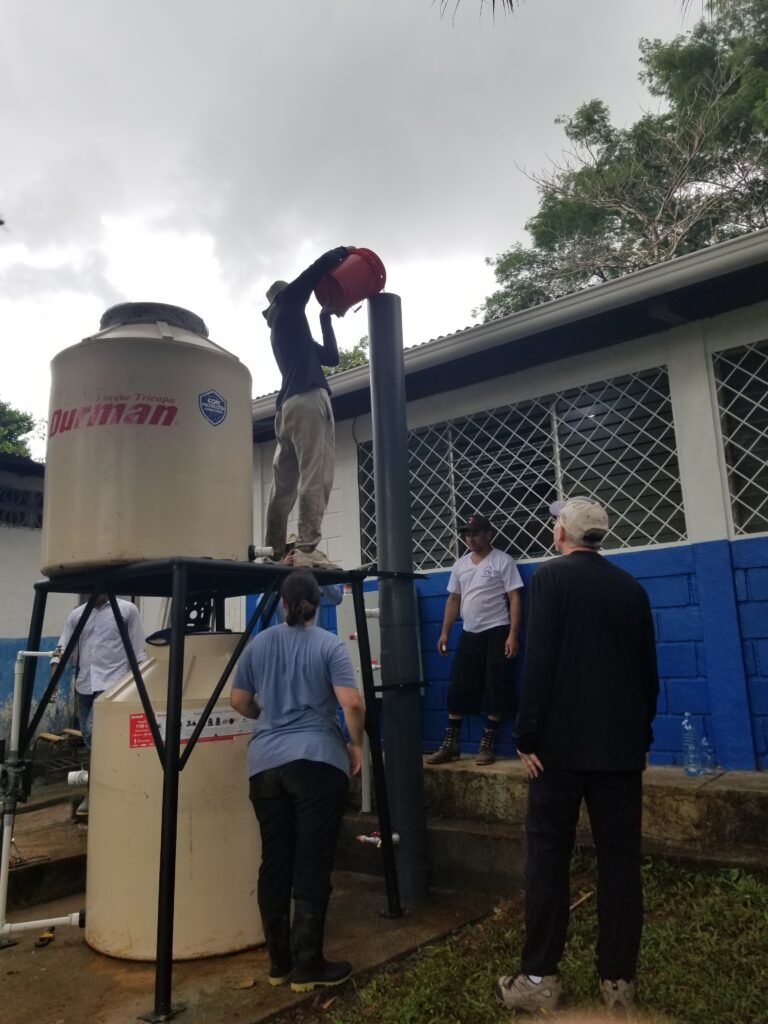
Rainewable is a low-cost, low-maintenance rainwater catchment and filtration system developed in partnership with the Texas Enactus team at the University of Texas at Austin.
The concept is simple. Rain falling on a tin roof is channeled through gutters into a first barrel, where sediment settles. The water then passes through sand and gravel filtration into a second, sealed barrel of clean water. Rio Blanco receives roughly 140 inches of rainfall annually, making rainwater collection a practical solution.
The system requires no electricity, pump, or fuel. In communities where the nearest hardware store may be hours away by unpaved roads, that simplicity matters.
Built for the Communities We Serve
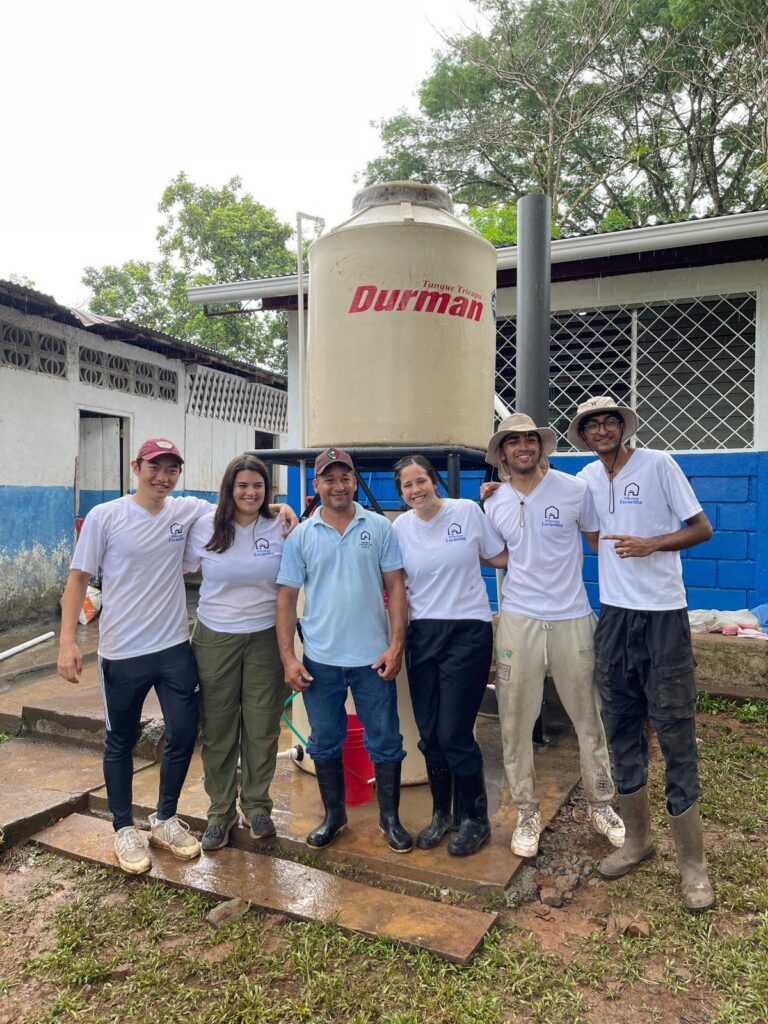
The design evolved through field testing. UT students first prototyped a remotely monitored version in Austin, then traveled to Nicaragua and rebuilt it alongside our head builder, Manuel. Using locally available PVC, hardware, and hand-sifted sand, the team transformed an academic prototype into a system a rural community could realistically maintain: two large barrels, no electronics, and no moving parts that can easily fail.
The finished system can be built on-site in about four days for under $5,000, a fraction of the time and cost of a fully distributed system.
San Isidro, Nicaragua: The First Installation
The first full Rainewable system was installed at the school in San Isidro, a farming community of roughly 300 residents whose primary water source was a river shared with livestock and consistently contaminated.
Before the system, fetching water was a daily responsibility that fell disproportionately on the school’s youngest girls, contributing to missed classes and illness. With the catchment system feeding the schoolyard, students can wash their hands between lessons and after using the outhouse. In its first year, the system served approximately 300 residents, including 40 students directly, while helping strengthen community hygiene knowledge and practices.
Most importantly, the system became something the community built and maintained rather than simply received.
Weighing the Design
Rainewable is not intended to replace our permanent spring-fed systems. It is a way to provide safer water while a community waits for a fully distributed system.
Rainewable is a bridge, not a destination: a practical way to provide safer water now while a permanent system moves through the pipeline.
It’s a small footprint of concrete, PVC, and rain barrels. But for a classroom that currently has no safe water, it can mean the difference between a school day interrupted by a walk to the river and one that isn’t.
1WHO/UNICEF Joint Monitoring Programme for Water Supply, Sanitation and Hygiene